Why R1234yf Costs More Than R134a Refrigerant
Automotive Refrigerants, R1234yf, R134a, Refrigerant Costs
Why R1234yf Is More Expensive Than R134a – And What That Means for Your A/C Bill
If you’ve had A/C work done on a newer vehicle lately, you may have felt some sticker shock. A big reason is the switch from R134a to R1234yf automotive refrigerants. At 37 Smog and Repair, we’re often asked why R1234yf costs so much more and whether it’s really necessary. Here’s a clear, trustworthy breakdown to help you understand what you’re paying for and why.
R1234yf vs R134a: The Basic AC Refrigerant Comparison
For years, most passenger vehicles used R134a as their A/C refrigerant. It was relatively inexpensive, easy to work with, and widely available. Newer vehicles now use R1234yf, a different type of refrigerant designed to dramatically reduce environmental impact. Both cool your cabin, but they differ in chemistry, regulations, and—most noticeably—refrigerant costs.
In 2026 U.S. market data, bulk R134a averages about $35 per pound, while R1234yf averages around $200 per pound, roughly 3.5 times more at the wholesale level (EPA data). At the retail-can level, R1234yf can be 4.5–5 times the cost of R134a per pound (thepricer.org). That gap is exactly what you’re seeing reflected on your invoice.
Why R1234yf Is More Expensive Than R134a
Several factors drive the higher price of R1234yf compared to R134a, and they all stack on top of each other:
Newer, patented chemistry: R1234yf is a newer HFO (hydrofluoroolefin) refrigerant. Newer formulas often carry licensing and production costs that older products like R134a no longer have at the same level, and those costs are built into the price per pound.
More complex manufacturing: Producing R1234yf is more technically demanding. That complexity means higher overhead for manufacturers and, in turn, higher prices for shops and drivers.
Regulatory pressure and limited suppliers: As R134a is phased out in new vehicles due to environmental rules, demand is shifting to R1234yf. Fewer global producers and strong demand keep prices elevated compared to older refrigerants.
Specialized equipment in the shop: Servicing R1234yf systems requires dedicated machines, fittings, and procedures. Those machines are significantly more expensive than older R134a units, so some of that investment shows up in the final service price.
💡 At 37 Smog and Repair, we clearly separate parts, refrigerant, and labor on your estimate, so you can see exactly how much of your A/C bill is pure refrigerant cost and how much is skilled diagnostic and repair time.
Understanding Refrigerant Costs on Your Invoice
When you see a line item for R1234yf or R134a on a repair order, you’re paying for more than just the fluid itself. A typical professional A/C recharge in 2026 runs about $283–$366 nationwide, including parts and labor (thepricer.org). For R134a systems, many shops land in the $150–$300 range, while R1234yf services often fall between $250 and $600, depending on how much refrigerant your system needs and what issues are found.
A midsize sedan might hold around 1.5–2 pounds of refrigerant. With R134a at roughly $35 per pound retail and R1234yf closer to $200 per pound, that difference alone can add over $250 to the parts portion of your bill. Add in leak checks, vacuuming, and proper recharging, and the total refrigerant cost is only one piece of a complete A/C service—but it’s a noticeable one.
Automotive Refrigerants and Environmental Impact
The main reason automakers moved from R134a to R1234yf is environmental impact. Both are automotive refrigerants, but they behave very differently once released into the atmosphere. R134a has a high global warming potential (GWP), meaning it traps heat in the atmosphere far more powerfully than carbon dioxide. R1234yf, by contrast, has a much lower GWP and breaks down in the atmosphere much faster.
Because of this, the EPA has ruled R134a “unacceptable” for use in new passenger vehicles starting with the 2026 model year (refrigerants.net). That means almost all new vehicles rolling off the lot today use R1234yf. You’re essentially paying more up front for a refrigerant that’s designed to be far less harmful to the climate over the long term.
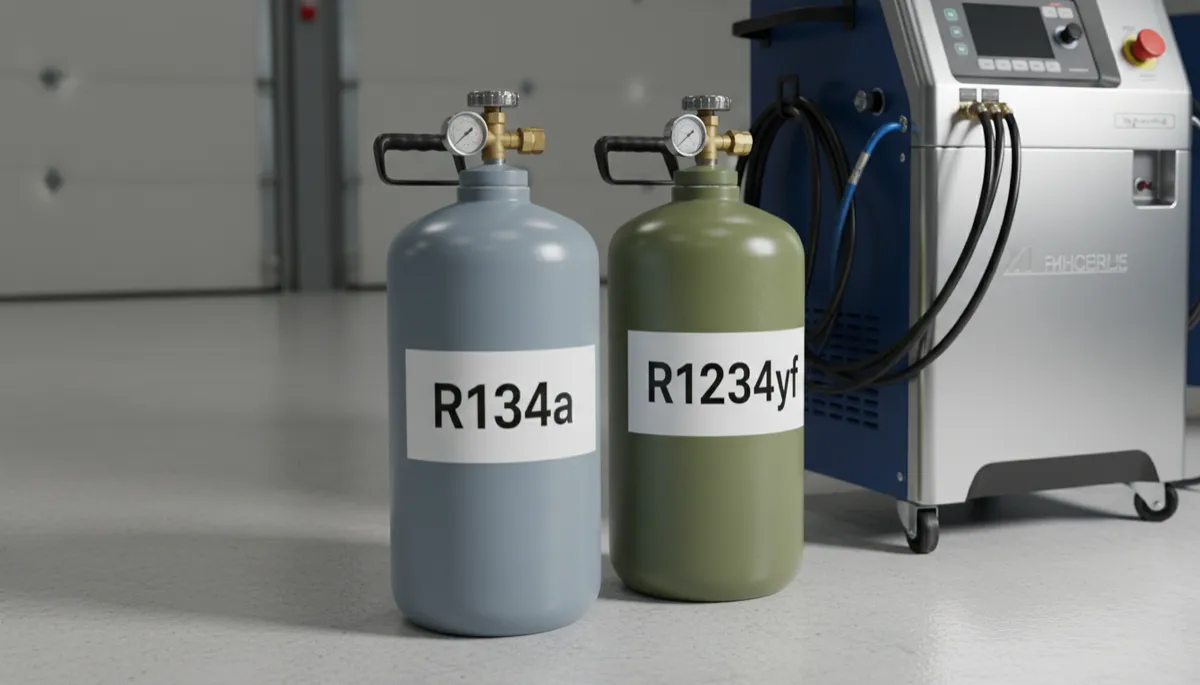
Newer R1234yf refrigerant costs more but significantly reduces climate impact compared to R134a.
Practical AC Refrigerant Comparison for High Desert Drivers
If you drive an older vehicle (generally 2014 and earlier), you’re likely still on R134a. Your recharge cost will usually be lower, but your system uses a refrigerant that’s being phased out in new cars. If you own a late-model vehicle, you almost certainly have R1234yf. You’ll see higher refrigerant costs, but you’re also driving a system built to meet current environmental standards.
Cooling performance: For most drivers, R1234yf and R134a feel very similar at the vents when the system is healthy and properly charged.
Service cost: R1234yf A/C work is typically $200–$400 higher than a similar R134a job, largely because of the refrigerant price and specialized equipment requirements.
Future availability: R134a will remain available for servicing existing vehicles, but the long-term trend is clearly toward low-GWP options like R1234yf.
📌 Key takeaway: You can’t safely or legally mix or substitute these refrigerants. The right choice is always the one your vehicle was designed for—and that’s exactly what we use at 37 Smog and Repair.
How 37 Smog and Repair Helps You Control A/C Costs
Our job isn’t to sell you as much refrigerant as possible. It’s to find the real problem and fix it correctly, so you’re not paying to recharge a leaking system over and over—especially with higher R1234yf prices. Before we add any refrigerant, we focus on:
Accurate diagnostics to confirm whether low refrigerant is the issue—or if there’s a deeper A/C or electrical fault.
Leak checks and proper evacuation, so your new refrigerant stays where it belongs and keeps you cool through our High Desert summers.
Clear, upfront estimates that separate labor, parts, and refrigerant costs, in line with our commitment to integrity first.
Whether your vehicle uses R134a or R1234yf, our ASE Master Tech–led team is equipped to diagnose, repair, and recharge your system correctly—the first time. That’s especially important if you’re also facing smog issues, a check engine light, or older-vehicle emissions concerns. We can address your A/C comfort and your smog readiness under one roof.
Ready to Get Your A/C and Smog in Order?
If your air conditioning isn’t keeping up with High Desert heat—37 Smog and Repair is here to help. We’ll walk you through your options, explain the refrigerant costs for R1234yf or R134a in plain language, and recommend only the work your vehicle truly needs.
Schedule your appointment today and let our team get your vehicle certified, repaired, or road-ready with honest, expert care. Don’t wait for the next heat wave—book your A/C service now and drive with confidence all year long.